

What counts as ODC cargo in India
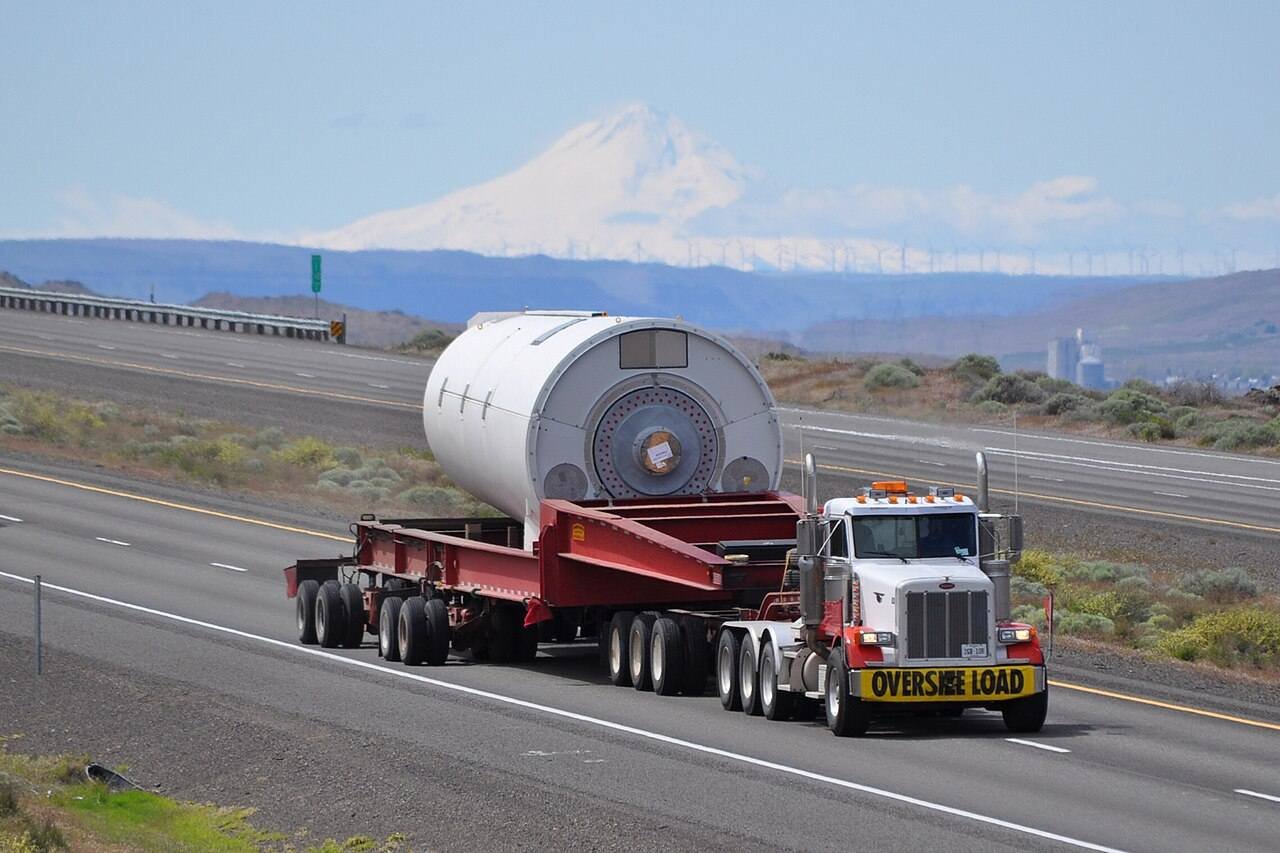
Over-dimensional cargo (ODC) is a single, indivisible load that cannot be dismantled for transport and that, once loaded, breaks the standard envelope for goods vehicles on Indian roads. In practice that means a load wider than 2.6 m, taller than 4.75 m or longer than 18.75 m. Heavy project cargo — power transformers, reactors, distillation columns, boilers, gas turbines, wind blades and bridge girders — is almost always ODC, and frequently over-weight (OWC) as well.
Industry also uses narrower labels: OWC for over-width, OHC for over-height and OLC for over-length. In this guide, as in most permits and policies, ODC covers dimensions and OWC covers weight.
| Parameter | Standard limit | Above it, the load is… | What the app does |
|---|---|---|---|
| Width | 2.6 m | ODC (over-width) | Softlock flag: “Cargo width x m exceeds road limit 2.6 m” |
| Height | 4.75 m | ODC (over-height) | Softlock flag on height |
| Length | 18.75 m | ODC (over-length) | Softlock flag on length |
| Weight | 40,000 kg (screening) | OWC (over-weight) | Softlock flag + axle-row / HT evidence |
| eWay Bill | “Vehicle Type: ODC” | ODC regardless of numbers | Independent trigger |
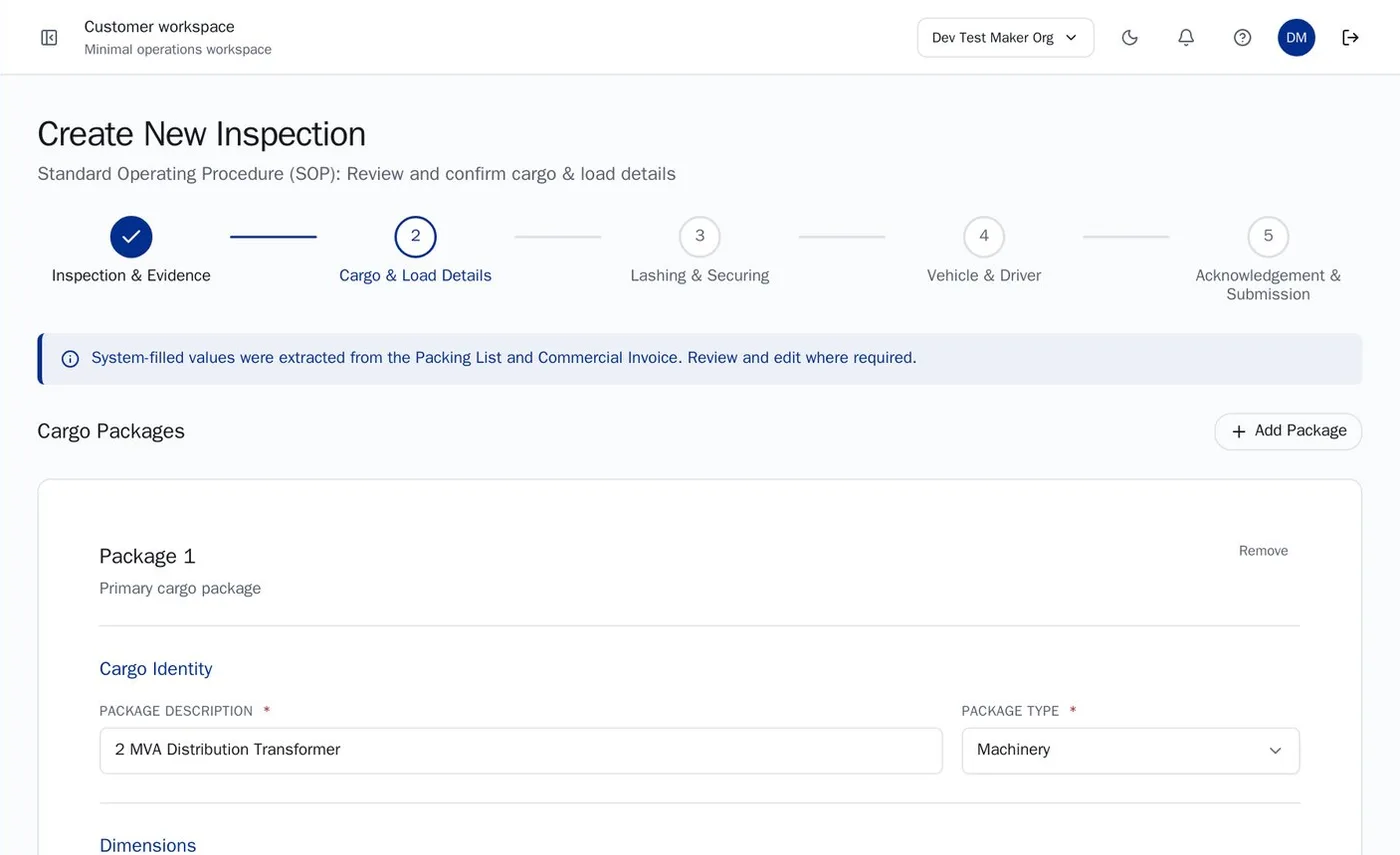
From the iCargoFinsure app · demo data · see more fragments
Permits and the rules that apply
ODC and OWC movements on National Highways need prior permission. MoRTH's circular of 24 January 2013 set out guidelines for OWC/ODC movement — including load composition tables and bridge-adequacy charts — and its circular dated 27 October 2025 governs online permission for single indivisible ODC/OWC units on modular hydraulic trailers (compositions HT-1 to HT-13). State highways and city roads need state PWD, transport department and police permissions on top.
Typical movement conditions you must be able to evidence include:
- Route survey by a competent engineer, with bridge and culvert checks for long spans
- Pilot vehicle with beacon, police escort where required, and no overtaking during transit
- Zebra markings and red danger flags on every projecting extremity
- Speed restrictions — down to walking pace on weak bridges — and night or peak-hour restrictions on busy corridors
- Weighbridge verification at origin
The GST eWay Bill also carries a “Vehicle Type: ODC” field. iCargoFinsure treats that flag as an independent trigger: if the eWay Bill says ODC, the job is ODC even if a typo in the packing list says otherwise.
The 8-block ODC inspection checklist
An insurer does not just want to know that the load was big; they want evidence it was secured, carried and handed over properly. ODC OK PLEASE organises that evidence into eight blocks:
- Cargo — description, HSN, value, L × B × H, weight, centre of gravity markings, condition and pre-existing damage.
- Conveyance — RC, fitness, axle configuration, trailer type (low-bed, semi-low-bed, hydraulic modular, extendable) and rated capacity.
- Driver — name, licence number, DOB, mobile and experience with ODC.
- Cities / routes / permits — origin, destination, corridor, permit copies, route survey and escort plan.
- Dunnage — type and condition of timber/rubber bedding and its friction coefficient.
- Chocking / sliding — blocking, welded stoppers and anti-slip measures.
- Lashing — type (chain, wire rope, web sling), count, MSL per unit and total MSL.
- Unloading — destination readiness, crane or jack-and-slide capacity and closure photos.
How AI speeds this up — without replacing the surveyor
On a typical job the surveyor receives a stack of PDFs and phone photos. iCargoFinsure's document intake uses Anthropic's Claude to read the commercial invoice, lorry receipt, eWay Bill, vehicle RC and driving licence and pull out around 80 fields — consignor, consignee, invoice value, vehicle number, driver details and cargo dimensions — into one canonical schema. Vision analysis reviews the site photographs for securing and damage.
Then the important part: the extracted data always goes to a human maker first, never straight to sign-off. OCR on Indian RCs, licences and handwritten LRs is not reliable enough to reach a signing checker unreviewed. The maker confirms or corrects in seconds, the rules engine runs its ODC/OWC and lashing checks, and a checker reviews and approves before the insurer-ready PDF and QR code are issued.
Want to see it? Try the ODC checker or book a demo.
Where ODC claims usually come from
- Load shift on braking or cornering because lashing capacity was less than the load demanded — or the dunnage was wet, oily or missing.
- Impact with overhead structures — flyovers, toll gantries, electric lines — when on-road height (cargo + deck) was never measured.
- Bridge and culvert damage or detention when axle loads exceeded the approved composition.
- Unloading accidents because the destination crane or jacking system was under-rated.
- Disputed condition at delivery because there were no geo-tagged, time-stamped photos at loading.
Each of these maps to an inspection block, which is why the evidence chain matters more than any single checklist.
Go deeper
Frequently asked questions
What are the ODC limits in India?
Loads wider than 2.6 m, taller than 4.75 m or longer than 18.75 m are treated as over-dimensional. Weight above legal axle and gross limits makes the movement over-weight (OWC).
Who issues ODC permits?
MoRTH/NHAI for National Highways through the online permission process for ODC/OWC, and state PWD, transport departments and police for state roads and urban stretches.
Is a 40-foot container ODC?
A standard ISO container is about 2.44 m wide and 2.59 m tall, so it is not ODC by itself. Out-of-gauge cargo on flat-racks, or a high-cube on a high deck, can be.
Does the eWay Bill show if a vehicle is ODC?
Yes, the eWay Bill has a vehicle type field that can be set to ODC. iCargoFinsure treats it as an independent ODC trigger.
Sources & references
- MoRTH Circular RW/NH-35072/1/2010 dated 24.01.2013 — Guidelines for OWC/ODC movement on National Highways.
- MoRTH Circular RW/NH-35072/01/2010-S&R(B)PT-2 dated 27.10.2025 — Online permission for single indivisible ODC/OWC on modular hydraulic trailers (HT-1 to HT-13).
- PIB — MoRTH notifies standardised transport vehicle dimensions
- Central Motor Vehicles Rules, 1989 — Rule 93 (overall dimensions of motor vehicles).