

ODC / OWC · Diwali 2026
ODC & OWC Cargo Inspection in India
207trips analysed
Watch the 45-second filmFrom this Diwali 2026
ODC / OWC will never be the same. Cargo risk, engineered into evidence.
Need one ODC inspection or a repeat programme? Place a bid by volume, weight and value.
About us
iCargoFinsure, powered by evidence.
Driven by engineering.
Heavy cargo needs more than a checklist. It needs one record that every party can trust, built the same way on every move.
- EvidencePhotographs, documents, cargo
- EngineeringForces, friction, securing
- AccountabilityMaker, checker, decision
- 207TripsFully anonymised
- 242InspectionsODC / OWC in 2025
- ₹226+CrExposure analysed
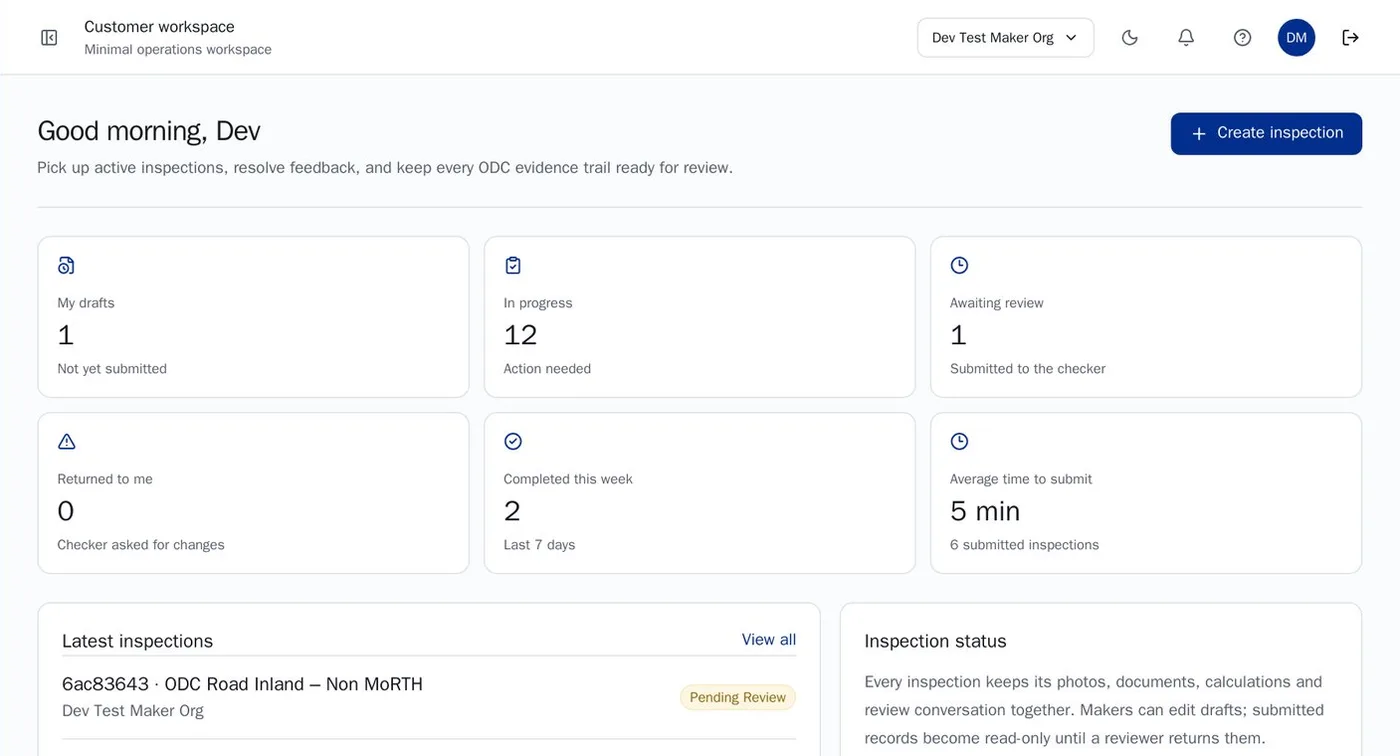
How it works
One job record, from the first photograph to safe unloading.
Step 1: Survey and evidence
Photographs, dimensions and condition captured at the cargo.
Step 2: Cargo capture
One standard record of what is moving, in metres and kilograms.
Step 3: Engineering checks
Securing capacity checked against the load, with the reasons shown.
Step 4: Route and FASTag monitoring
Movement and deviation tracked against the approved route.
Step 5: Compliance and insurance
Permits, policies and records kept with the job.
Step 6: Safe unloading
Delivery readiness and closure evidence, then the record is signed.
Every AI-assisted reading is confirmed by a human maker and signed by a checker. Nothing is approved by the software alone.
Real reports
Same physics. Three verdicts. Every move is a contest. The cargo pulls one way; the vehicle and the lashings must hold the other. Download three real inspection reports, with names, tax numbers, vehicles, drivers and addresses removed, and see where each one landed.
Action: what the move asks of the load Reaction: what holds it Where the bars meet shows who is winning.
Download This Report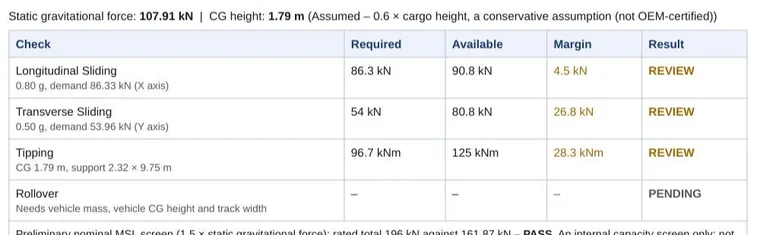
Loading
Inside the payload by 15,820 kg
Lashing
Holds, 4.5 kN to spare
Provisionally adequate. The report lists what is still assumed (centre of gravity, friction, lashing angles) so the checker can close it.
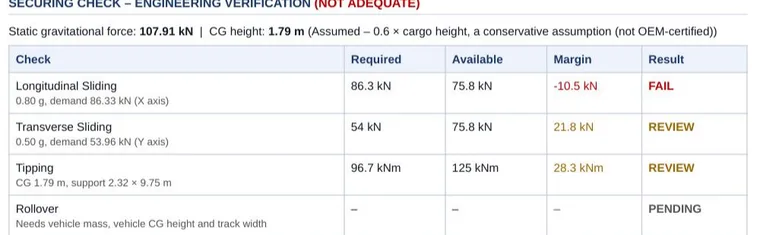
Loading
Inside the payload by 15,290 kg
Lashing
Short by 10.5 kN
The total lashing capacity passes the 1.5× rule (196 kN against 161.9 kN), but the lashings that oppose the forward pull are not enough. The move is conditional on more hard securing at the front and rear.
Loading
Over the payload by 11,250 kg (27.61%)
Lashing
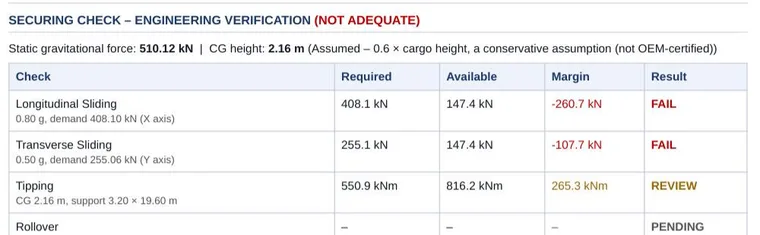
Short by 260.7 kN
Movement clearance on hold: the cargo exceeds the vehicle's registered payload, and the lashings are far short. Caught before the truck moved.
Real inspections, redacted. The securing check is an internal screen on stated inputs, not a certified calculation. Figures are the report's own.
Who it is for
Your pain points deserve a better inspection solution. You are:
- Surveyors and loss adjustersLess repetitive reporting, one professional workflow. Join the Surveyor Network →
- Freight forwarders, CHAs and transportersLess coordination friction on every heavy move. Become a Logistics Partner →
- Shippers, manufacturers and EPC companiesCatch securing and loading gaps before cargo leaves the gate. Request an ODC Inspection →
- Insurers and brokersUnderwriter-readable evidence, before and after a loss. Explore Enterprise Partnership →
What our clients say
Early results from two pilot clients.
Inspect first, and the losses and the inspection spend both move. Figures are reported by iCargoFinsure from client pilots; clients are not named.
2×Reduction in loss ratios
Reduction in loss ratios: 2×. Reduction in inspection expenses: 0.5×.
Transformer client 1Power transformers · pilot, April to December 2025Client-reportedReduction in losses: 1.3×. Reduction in inspection costs: 0.5×.
Chiller client 2Industrial chillers · pilot, April to December 2025Client-reported
Anonymised, client-reported pilot figures for two clients, April to December 2025: loss ratios on annual turnover and survey fees. The basis is in the research papers on SSRN and Zenodo. Clients are not named. Results vary by cargo, route and operator and are not a guarantee.
FAQ
ODC and OWC questions, answered.
Find answers to common questions about ODC and OWC cargo and our inspections
What is ODC cargo in India?
ODC (over-dimensional cargo) is a single indivisible load that, once loaded, exceeds India's standard vehicle dimensions — 2.6 m width, 4.75 m height or 18.75 m length. Transformers, reactors, wind blades, boilers and bridge girders are typical ODC. Movement on National Highways needs prior MoRTH/NHAI permission and state permissions where applicable. See our ODC inspection guide.
What is OWC (over-weight cargo) and how is it different from ODC?
OWC is cargo whose weight pushes the vehicle beyond legal axle or gross limits. ODC is about size, OWC is about weight; heavy project cargo is often both. OWC usually moves on modular hydraulic trailers where MoRTH limits each axle row to 18 t and prescribes HT-1 to HT-13 compositions. Read the OWC guide.
How does iCargoFinsure use AI in an ODC inspection?
Claude-powered extraction reads the invoice, LR, eWay Bill, RC and driving licence (around 80 fields), vision analysis reviews the site photographs, and a rules engine checks dimensions, weight, the eWay Bill ODC flag and lashing capacity. A human maker confirms everything, and a checker approves before an insurer-ready PDF with a QR code is issued.
Does the AI approve the inspection on its own?
No. AI output always lands in the maker's court first, even on a clean parse, and only a checker or admin can approve. The MoRTH dimension and weight softlock is advisory — it flags and explains, and the checker sees the reasons at review.
Can lithium-ion BESS containers be inspected on the platform?
Yes. Containerised battery energy storage moves as UN3536 (lithium batteries installed in cargo transport unit), a Class 9 dangerous good. The workflow captures the DG paperwork, placards, shock/tilt indicators, twist-locks and securing evidence. See the BESS transport guide.
What does an iCargoFinsure inspection report look like?
It is a short PDF: who and what is moving, the vehicle and driver checks, a securing check that sets the force on the cargo against what the lashings hold, ten photographs, and a verdict. Three real reports, with names, tax numbers, vehicles and drivers removed, can be downloaded from the Real reports section of the home page. See the three reports.
How does bidding work?
A bid is your intent to move ODC cargo: one inspection or a repeat programme, over volume, weight and value, in the MoRTH or non-MoRTH category. Send it on the market page and the team responds to your bid. There are no public prices; each bid is answered for its cargo.
Who is ODC OK PLEASE built for?
Corporates and assureds shipping project cargo, independent surveyors, insurers and brokers underwriting transit risk, and transporters/EPC teams who move the load. Everyone works from one evidence chain — cargo, conveyance, driver, route, dunnage, chocking, lashing and unloading.
Is the ODC checker on this page a permit?
No. It is an indicative screen using the same thresholds our rules engine uses. Permits, route surveys and bridge adequacy are decided by MoRTH, NHAI, state PWDs and the route surveyor.
Have a heavy move coming up? Book a live demo.
See what this means for your next heavy move.
Book a Live Demo